this blog is the platform for publishing the research conducted by the students of the "Prehystories of New Media" class at The School of the Art Institute of Chicago (SAIC), Fall 2008, instructor: Nina Wenhart

tagging

for tagging, please only use your name and the title of your paper only, so that we'll get an index. make sure that you end your tag with a comma.

here is an example:
Nina Wenhart: Prehystories of New Media,
thanks!

students' blogs

readers

Tuesday, November 4, 2008

Bonny Vanatta: The Square vs. the Cube

The Square vs. The Cube

Bonny Vanatta


Abstract: Artists Manfred Mohr and Josef Ablers have what on the surface appears to be a similar fascination with the square and color. Delving deeper into the motives and processes employed in the making of their work reveals their drastic differences. Manfred Mohr uses the computer to make his hypercubes (4 and greater dimensions) in the series “space.color,” and Josef Albers uses a palette knife and paint in his series “Homage to the Square.” The author of this essay uses these two artists to understand the difference between computer arts and hand-made arts. She boils the differences down into one main issue: separation. She argues that the artist becomes too separated from his artwork when using a computer. She is also admittedly biased due to her painting background.


As a child, I used to play with the family computer. I would open up the painting program and try to find some way to express what I could easily render with pencil and paper, onto a computer screen. This was in the early nineties, so unfortunately, the odds were not in my favor and I rarely came up with the final product I had intended. I experienced enough difficulty in learning how to render something from my imagination onto a page using a pencil and my own hand, but once removed even further by a mouse to a computer screen, I was hopeless. This separation, or removal of the artist from the work, intrigues me. When looking at two superficially similar artists, Manfred Mohr and Josef Ablers, I noticed that this computer related removal differentiates between these two men, and the works that they produce. In his series, “Homage to the Square,” Albers uses a palette knife to apply the paint, while Mohr uses a computer in his “space.color” pieces. After reading more about both, I started to wonder if using a computer takes too much out of the artist’s hands, resulting in too much separation of the artist from his work.
To get the best understanding of an artist’s work, a look into his background helps the outsider to see the art from his perspective. I will start with Josef Albers since he started making art first. Albers was born in Bottrop Germany in 1888. He received an early art education in Berlin, Essen, and Munich. Early on, he became influenced by artists such as Edvard Munch and the Futurists and began painting abstract paintings in 1913. Joining the Bauhaus in Weimar added significantly to Albers’ artistic career. From 1922 he conducted the glass workshop there until the Bauhaus moved to Dessau in 1925, where he was then invited to teach. He taught basic design courses emphasizing an analysis of materials and form. His own works took many different forms: abstract paintings, paintings made by sandblasting glass, furniture, murals and prints. When the Bauhaus closed in 1933 due to the German Government, Albers and his wife, Anni Albers, went to the United States. The Black Mountain College, a school focused on art, in North Carolina invited them to teach. Here, Albers taught the way that he learned to teach at the Bauhaus, using the square format used by Kandinsky. In 1949, he started painting a series called “Variants” that dealt with intricate and complex arrangements that highlighted color relationships. Then, in 1950, Albers started teaching at Yale University and soon became the chairman of the art department. This same year he also started his “Homage to the Square” series. He would spend his summers teaching around the United States and Latin America. He also wrote a book called The Interaction of Color that culminates his lifelong study of color.1 He died in 1976.

Manfred Mohr, also from Germany, was born in Pforzheim in 1938. In 1957, he served an apprenticeship as a goldsmith because his father wanted him to become a jewelry designer. He also attended the School of Art and Design in Pforzheim. There, his professor Karl Heinz Wienert and Adolf Buchleiter introduced him to avant-garde art. Mohr won a school prize of the City of Pforzheim in 1962, and with it a scholarship to a partner school located in Barcelona, in which he enrolled, but never took any classes. While in Barcelona, he joined the rock group of singer Rocky Volcano. They toured Spain for two years making records and getting arrested, until Rocky Volcano bit the lead guitarist in the ear; they then disbanded. This was not a problem because Mohr and Jürgen Leudolph had already founded a private jazz club in Pforzheim. Mohr thought of himself much more as a musician than as a painter during this time. He played tenor sax and oboe in two jazz groups. Clearly his extensive background as a musician affected his artwork greatly, giving it rhythm and shape. When he did paint in 1962, he worked only with black and white, an act that many say point to as the first step toward computer arts; the use of black and white could be compared to the binary code of a computer. In 1963 and 1964 he enrolled in the École des Beaux Arts in Paris and in 1965 won the prize for lithography in 1965. From that year on, he gave up his former practice of action painting and moved to painting more logical, precise, architectural and geometric paintings. 1968 was a big year for Mohr. It was the year of his first gallery exhibition in Paris, the year that he wrote his book (published in the following year) called Artificiata I, and most importantly, the year that started him on the path of using a computer in his art. He saw in French television information about the Meteorological Institute of Paris and its new automatic plotter for the computer. After seeing it draw isobars and plotting wind directions across paper, he became inspired to use this new tool. He went to the institute and asked to use their machine for artistic purposes. The researchers, both curious and surprised, consented. He made art there until 1981 when the plotter was taken out of service. In 1969, he had his first exhibition, but the public reproached him for his methods. He did not give up though, and learned how to write a computer program with the direction of Pierre Barbaud (the first musician in Europe to compose with a computer). He also had some persuasion from Max Bense (the German art theorist).2 In 1972 Mohr began to work with the cube and in 1977 he began working with the four dimensional hypercube. By 1980 he was already dissecting the cube and in 1987, he had his first retrospective exhibition that renewed his original work with the hypercube, pushing him to branch out to five and six dimensions in 1989. In 1997 he was such an established artist that he was elected a member of the American Abstract Artists. He started to use color again in 1998 to better show the complexity of the work by differentiating planes. He lives and shows his work today.3

In order to adequately compare the works of these two artists, I have chosen one series from each of their long careers. For Josef Albers I have chosen his “Homage to the Square” series, and for Manfred Mohr I have chosen his “space.color” series. These two series have many elements in common which make them comparable, but their differences highlight the issue I am trying to resolve.

In the “Homage to the Square” seriesi, Albers made many studies of the deceptive, relative, and instable beast that is color by using the square. The square is a basic element of design and is a creation of the human mind for it very rarely exists in nature. The square solidly holds the colors and allows them to react against each other. He describes the square as a perfect stage for the color to perform. In keeping only four slight variations in the square setup of his paintings4 he gives the square movement by varying the colors used each time. The color relationships play with the viewer, some color squares pushing forward, others pushing back, and some vibrating upon contact with another. This series speaks to the relativity of color. People never see just one color purely alone, but always in relation to others. This relationship defines the color just as much as any name tagged onto it. It is this careful observation of color relationships, and various palettes, that create different moods and climates in a painting.5 He likened the way that colors interact with each other to the way that people interact. He paints about man in self-realization, and realization of relationships with others. A person has to be an individual and a member of society.6

Josef Albers’ methods of building a painting in this series draw many parallels to how computer artists work. First, in the layout, he precisely draws out three or four squares inside each other in which to place color. The strict ratios and placement mimic the strict, graphic quality of computer arts. His ground is made up of the whitest whites available at the time, so as not to distort any color. After making a solid base, he uses his palette knife to apply the paint onto the surface as thinly and evenly as possible. He applies the paints directly from the tube, without mixing colors (except colors not available in tubes in which case some white was added) to ensure the purest results.5 All this seems to be evidence of a computer artist just without the option of a computer, but Albers purposefully left the edges where the colors meet to reveal slight imperfections as proof that he applied the paint by palette knife. This action keeps his balance between a hand-made art and that made by a machine.7

On the other hand, Manfred Mohr actually uses a computer to make his series. His “space.color” series was the first color series he made since making only black and white images. He uses color to help define the complex form that is a six-dimensional cube. Mohr’s random color differentiates between his use and that of Albers; it serves to aid the viewer in making sense of the puzzle he presents.8 Different planes push forward and backward and lines create space at the same time that they negate it. This series of mathematical conundrums holds together, while simultaneously allowing each individual piece its own voice.ii

Because Mohr’s methods are integral to the conceptual aspect of the artwork, they must be discussed together. He uses a computer for its speed when working with such difficult and abstract concepts. He develops algorithms and uses the machine as an extension of his own knowledge by allowing it to calculate possibilities that a human could never conceive alone. In his algorithms, he introduces random parameters that do not disturb the fundamental structure of the cube, but provide an added element of unpredictability in the work. This unpredictability is not human error though. He uses the computer because it is free of human error, and also guarantees reproducibility. This method of working emphasizes that his art is determined rationally, not emotionally. No personal touch of the artist is visible. He separates viewer and artist from art work even further by creating an algorithm for an incomprehensible cube, something people intellectually cannot connect to, and then repeating the product for effect. He repeats his display of mathematical hierarchy of knowledge. He does not strive to make beautiful pieces of art, but instead seeks to produce a series that gives flat surfaces spatiality in an incredibly complex way.9

I am a painter. I have to keep in mind that my painterly bias naturally falls towards Josef Albers because I understand him already. I chose to embark on this soul-searching journey of an essay in an attempt to understand why it is that I lean so heavily toward Albers as opposed to a similar artist, Mohr, who clearly has hard drives full of artistic knowledge. My conclusion is simple: Manfred Mohr has removed himself from the art that he creates by placing too much of the process into the computer, preventing me from connecting to the finished products.

Mohr’s separation makes his pieces less emotional, and thus less approachable to the viewer. He purposefully makes algorithms, cold and mathematical by nature, and plugs them into a flawless computer that then creates something reproducible. I have flaws and am one of a kind (like everyone else in the world). I respond to flaws and find them beautiful. Albers left his handmade flaws for the viewer to see that he too makes tiny mistakes and his work has a more personal feel because of it. I also appreciate that great art happens in a window, a fleeting moment, that the artist alone knew how to catch. Each brushstroke or palette scraping tells the viewer a little more of the story about the captured moment. When Mohr removes the moment out of the piece by taking out any sign of its making, and reproduces that image, the special quality of that shared moment leaves the piece. I do not know what he thought about when making “space.color.” I have no idea because the middleman, or the computer, blocks my emotional reading of them.

I honestly do not understand this emotional blocking. In my opinion, art and emotions ventured forth into this world from the same womb. And, just as twins separated from birth tend to cut their hair the same length and break their legs at the same time, art and emotion increase in greatness together, and consequently, fall together as well. Art stirs people to emotions, and emotions stir people to art. I believe that it also drives tastes. I tend to like what emotionally attracts.

On the other hand, I understand that Albers hardly had an overflowing amount of emotion in his mark making or his choice in shapes for his series. I still find it far greater than in those of Mohr’s though, possibly because of the image it conjures. The viewer, when learning that each of the “Homage to the Square” paintings is in fact a painting, realizes that Albers labored over each of these pieces, painstakingly spreading the paint as thin and even as possible. Images come to mind of an elderly man hunched over a square board, palette knife in hand, nose inches from the surface, calculating the pressure of his arm and the varying thicknesses of paint.

Beyond that overly dramatized version of a possible reality, his color choice too certainly adds another layer of emotion to his series. Albers specifically chose his colors to create specific effects. He created moods and climates while simultaneously creating depth and movement. He took every characteristic of each color employed into account before touching paint-laden palette knife to board. He had immense control over his works because he carried out each minute piece of the process with his own hands.

Mohr creates an algorithm, but after physically plugging it into the computer, he has no more direct contact with the work until he removes the finished page from the printer or installs the flat screen display to the wall. The computer logically does all the computing and then displays options for Mohr. These options have differences due to the randomness that the artist inserted into the algorithm. This randomness takes control away from Mohr until he later decides which random result creates space the way he wants it to. His color too is random. The palette being chosen by him beforehand allows colors to appear in planes without his direction. This takes too much out of the artist’s hands and allows the tool to be too smart.

I also find myself questioning the point at which the intellectual aspect of the piece becomes too powerful for the aesthetics of the piece. Mohr’s work overwhelms me with its intelligence, but that intelligence poses a problem for the aesthetics. Too much mathematics happens and not enough concern for the visual presentation of this complicated idea. This overwhelming amount of mathematics also serves to push the viewer away. Conversely, Albers’ highest concern is his finished product. The way that the colors move with each other, their push and pull, becomes much more exciting than the concept behind it. This movement he created draws viewers in.

All this being said, I appreciate both artists greatly and find their work refreshing. Unfortunately, a good majority of artists do not value the intellectual aspect of art nearly as much as I believe it deserves. These two series though are based on very intellectual concepts. Both Mohr and Albers took considerable time and energy to make works that keep the viewer thinking. I am and always will be a painter, but I have great respect for a smart artist employing any tool.

1 Kynaston L. McShine, “Josef Albers.” Homage to the Square. New York, NY: The International Council of the Museum of Modern Art. 1964.

2 Kurtz, Thomas. “The Courage of One’s Convictions.” Online Article. 1994. Manfred Mohr Website. Oct. 15, 2008.

3 Biography. Manfred Mohr Website. Nov. 13, 2008

4 Overy, Paul. “The Work of Josef Albers: A Recognition of Restrictions.” Josef Albers: A National Touring Exhibition from The South Bank Centre 1994. Eastbourne, Sussex, England: Pegasus Graphic Production Ltd, 1994. 32.

5 Kynaston L. McShine, “Josef Albers.” Homage to the Square. New York, NY: The International Council of the Museum of Modern Art. 1964.

6 Overy, Paul. “The Work of Josef Albers: A Recognition of Restrictions.” Josef Albers: A National Touring Exhibition from The South Bank Centre 1994. Eastbourne, Sussex, England: Pegasus Graphic Production Ltd, 1994. 36.

7 Josef Albers: A National Touring Exhibition from The South Bank Centre 1994. Eastbourne, Sussex, England: Pegasus Graphic Production Ltd, 1994.

8space.color. 2001. Manfred Mohr Website. 17 Nov. 2008

9 Mengden, Lida von. “Manfred Mohr – Research in the Aesthetic Universe of the Cube.” Online Article. 2007. Manfred Mohr Website. 15 Oct. 2008. < http://www.emohr.com/ww2_out.html>

i Example Albers Images:


Study for Homage to the Square;1963

Oil on plastic and board

Support: 762 x 762 mm

Painting

Presented by Mrs Anni Albers, the artist's widow and the Josef Albers Foundation 1978

<http://www.tate.org.uk/servlet/ViewWork?cgroupid=999999961&workid=473&searchid=10298>


Study for Homage to the Square;1964

Oil on plastic and board

Support: 762 x 762 mm frame: 780 x 780 x 30 mm

Painting

Presented by Mrs Anni Albers, the artist's widow and the Josef Albers Foundation 1978

<http://www.tate.org.uk/servlet/ViewWork?cgroupid=999999961&workid=474&searchid=10298>


ii Example Mohr Images:
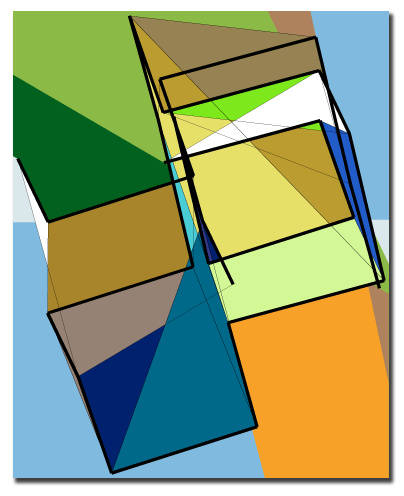


P-701/B

enduraChrome / canvas

1999;141cm x 114cm

<http://www.emohr.com/ww4_out.html>
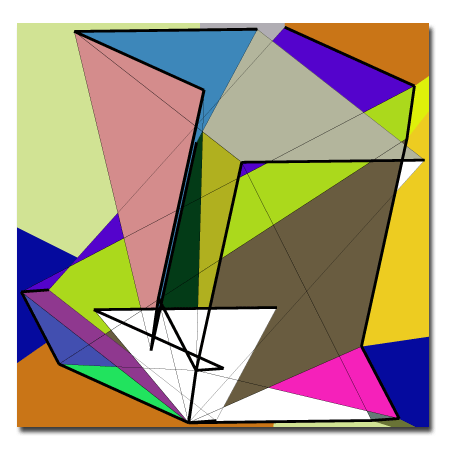


P-708/K

enduraChrome / canvas

2002;80cm x 86cm

<http://www.emohr.com/ww4_out.html>


Minnie Vogts: Frieder Nake + Paul Klee

Eve Sanford: Hip Hop or Not Graffiti Alternatives

Evelyn Sanford

In its infancy hip hop culture and music was viewed as radical in the same way its predecessors rock and disco where. Like rock, hip-hop has paid it dues and without a doubt cemented itself as a valid genre despite doubters expectations. Hip hops music fashion and over all culture appeals to way more than simply the inner city urban black listener. Its expansion and influence is seen in many facets of everyday life around the world. Media outlets like television, radio, and advertising that in the beginning may not have cared to cater to the trend now feverishly aim to capture it.

“Hip-hop is a moving cultural force that first garnered the attention of corporate America in the early 90’s. When hip-hop made its debut into mainstream, corporate heads began to turn. Enterprising brand managers embraced the culture and soon realized substantial results.”(ZIBS Blog) There is no doubting this is a fact when you see advertisement from almost every major fashion label and car company using hip hop icons as the face for their new products. Hip hops branding not only made it not only more acceptable but also much more available or visible to people around the world. Now like anything that starts off small this expansion is nothing short of a dream come true.


Unfortunately with every “make it big story” there is always a downside. “Among its influences, hip-hop transcends boundaries in politics, music, fashion, and other forms of entertainment. With 100 million fans worldwide, hip-hop also dominates many parts of mainstream media. Filmmakers, television show writers, and print publishers for example, are among media professionals who readily incorporate hip-hop lingo and fashion concepts in their products.” (ZIBS Blog) So what we are basically looking at is a culture that got extremely popular so naturally more music labels pick up and market these artists. They make them saleable to a larger audience. People buy into the new popular images so much so that other companies buy the image again to use to sell their products. The public again loves this well packaged “hip hop” and then it gets shipped around the world. In the end we have icons who are picked up and packaged and go on to be marketed all over the world.

However in most cases I think the popularity and branding of the culture brings about many deviant portrayals of what really going on. After awhile you have outlets like MTV, BET and advertising largely dictating what hip-hop looks and sounds like. So what is this thing that’s being represented all around the world? Unfortunately it is not hip hop at it core this how so many projects that want to connect with hip hop go wrong. They have been misguided from the start therefore what they produce is oddly ill fit.

There are so many people from all over the world and the United States who only have popular controlled media to expose them to things so are ever really understanding what they follow? If your only access is very strategically planned, plotted and delivered then how genuine is your experience? How accurate are your results when you attempt to represent what you see? I immediately thought of these issues when I saw some of the projects brought forward by the Institute for Applied Autonomy and Graffiti Research Lab. First and foremost the people behind these groups seem to be both very educated and passionate about they’re work. I however have concerns. These alternative advanced technologies developed by IAA and GRL to assist the graffiti artist I believe disregard the principal and purpose of traditional graffiti. If you have an understanding of how graffiti started and what and important part of the process itself lends to and reflects the outcomes than I think there efforts would have different results or draw closer connections between hip hop culture and there results

To its benefit one of the two aforementioned groups the Institute for Applied Autonomy made some effort to disconnect their project. They seemed to understand on some level that there was a difference between what they are doing and the art from in its traditional and current context. “Graffiti Writer is a tele-operated robot which employs a custom built array of spray cans to write linear text messages on the ground at a rate of 10 miles per hour. These messages are similar in form to dot matrix printer output, and are not intended to imitate human graffiti. Rather the Writer's aesthetics are purely mechanical, prompting the viewer to wonder, "What kind of machine wrote this?" (Institute for Applied Autonomy)

Even though IAA makes this statement as a premise to the introduction of the “Graffiti Writer” I asked myself what the point was really? Given the specifics about the machine itself and even its name. I am confused as to why IAA wants the connection to be made at all.


If I on some level assume the position that the "Graffiti Writer” project isnot a graffiti writer really then why call it by that name? To what benefit is that to them? Finally why would they then also use spray paint?

I think the answer to these questions can be found under the same file as the statement made about hip-hop and advertising. I believe the Institute for Applied Autonomy sees the link as an attention grabber for their audience. The graffiti writer as an element of hip-hop has an immediate affiliation with that “cool factor”. It is hip, urban and dangerous to run around tagging on trains and buildings. There is a definitive provocative appeal to that action. IAA is using this notion to advance the appeal of these random robots it develops. In actuality if you wipe away the spray paint from their process all you are kind of left with is a remote controlled car, a van and a vocal newspaper stand.

In the IAA’s mission statement they talk about being interested in self-determination and to provide technology that extends the autonomy of human activists. Undoubtedly being a graffiti artist is about self-promotion and requires a sizable amount of determination to become well known. Though graffiti artists are careful not to get caught in the act, complete autonomy is not the goal of the artist. “everyone who wanted to be recognized as the best artist or the "King" or "Queen" of a subway line got- up, i.e., painted trains as often as possible. If one's name was on a train in a colorful and unique style, it was guaranteed to be seen by many people; most importantly by the other writers, because the subway trains in New York City travel in circuits throughout different boroughs. To be a "King" or "Queen" one could not just get-up or simply paint his or her name in a thousand different places. On the contrary, style and artistic talent were and continue to be extremely important. The goal was and is to create burners which are pieces that stand out because of creativity, color, vibrancy, crisp outlines, i.e. no drips, and overall artistic appeal. It is the recognizable artistic talent of the graffiti artist that established his or her reign on the subway line and not just the appearance of s name in a thousand different places.” (Graffiti Art)

This clearly is in contrast to everything IAA’s Contestational Robotics is about in theory on down to production. Most importantly the IAA claims that developing these robots as a way to assist the human rebellious activity and to also met the budgets of such groups. I am extremely confident that the average graffiti artist doesn’t have a budget that would include the purchase of a robot assistant. Moreover the robots abilities are not compatible with the artists needs. These machines are “tagging” things out in the fashion of dot matrix printers. As the goal of the artist is to stand out based on his or her aesthetic in comparison to their peers, I am not convinced how dot matrix text messages will advance this goal.

Finally and most importantly the risk involved in becoming one of the best graffiti writers in an integral part of the process. The exchange of battle scars, scraps and close calls are a part of the fuel and pulse to the art form. These risks the IAA is avoiding by removing the personal experience are key to the appeal of the trade to the average person. It is apart of why they formed their project around the graffiti writer to begin with.


I find it interesting that they assume they are assisting and advancing a very specific rebellious behavior by extracting all the key components required to pull off the act.

One more interesting participant in “new and improved” graffiti is the Graffiti Research Lab. Unlike the Institute for Applied Autonomy GRL has many projects in within it attempts to assist or redefine the role and approach of the graffiti artist. The Graffiti Research Lab also confidently attaches itself with the hip-hop genre unlike the more reluctant IAA. There is something about that assurance that makes my response to their work all the more crude. The Graffiti Research Labs most famous project would likely be the LED bombing.

“LED Throwies are an open source graffiti technology developed at the Graffiti Research Lab”(Graffiti Research Lab) What the GRL did was take an LED, a battery and a magnet and tapped them together. The battery keeps the LED lit for a few days and the magnet allows for the light to stick on any metal surface. During these “bombings” the GRL, their affiliates and in some events random members of the public would throw the lights on large public sculptures, buses and other things metal. After a few moments the appearance of these objects is obviously altered because hundreds and thousands of these tiny colorful lights illuminates it. In my opinion they just kind of making things look a lot more like Christmas instead of really creating the effect of graffiti.

Now honestly in some cases it looks kind of cool they even figured out a way to make text by drilling the text into a board, putting the LED Throwies in the holes and popping that onto a walls or beams. Even still here again we have structural components that takes the project away from the classification of graffiti. Actual graffiti bombs are those large-scale complex and aesthetically sound paintings how does GRL consider LED Throwies be a form of bombing. The connection can be made because it is done usually at night and meant to change the way a structure is seen but under that same definition I could very well link it to construction. Could they also be named the Construction Research Lab?

Another GRL project that is assumed to be in alliance with graffiti culture is L.A.S.E.R Tag. “In its simplest form the Laser Tag system is a camera and laptop setup, tracking a green laser point across the face of a building and generating graphics based on the laser's position which then get projected back onto the building with a high power projector.”(GRL Laser Tag Rotterdam) Now this project actually does reference and mimic something very specific that a graffiti writer does. Tagging is typically a small scale why that writers advertise themselves by just throwing up there names in public places, buildings, train, etc. In theory with this project GRL has done what there mission statement suggests, outfitted graffiti artists with open source technologies for urban communication.

Haplessly in execution it again lacks crucial components and is irrational for use in a casual manner. When talking about traditional graffiti there is again this provocative, dangerous aspect to the process it also is crucial that these bombs are intended to have a lasting presence. GRL has removed the connection of acting out the experience by eliminating the writer from actually needing to be in the space. The LASER Tags are beginning projected from hundreds of feet away and they are projections which areextremely temporary. They are up and then gone in a matter of minutes. Where is the quality of danger and excitement? Where is that youthfulness, exploration and urgency?

The LASER Tag projections are interesting and different but I don’t know why they should be considered graffiti or even minimally an aid to graffiti writers. The amount and cost of equipment needed to pull off these stunts are enough to guarantee that any actual graffiti artist will not be using this machine. In the videos posted on the GRL website you can see that it takes more than one individual to haul and operate this technology therefore making it redundant for any artist looking to single himself out due to his own process to use the system. It would no longer be his or her process. It also lacks the every so important ability to create imagery that is engaging beyond complex line work. I do believe that LASER Tag is a very intriguing tool but again I’m not convinced it is relevant and practical for a graffiti writer’s purpose.

The Graffiti Research Lab has a few projects that deal with the line between graffiti and advertising. The GRL would be fine continuing to create work that deal with more social commentary and outsider arts but should see how that is different from the graffiti. Leave the graffiti to the graffiti artist and by all means run free with all else.

Graffiti Research Lab like the Institute for Applied Autonomy fall short of their targets. That target is being apart of graffiti and hip-hop culture. These alternative advanced technologies developed by IAA and GRL disregard the principal and purpose of traditional graffiti. They are both groups of talented individuals. Their knowledge of technology and equally their ability to create unique tools is undeniable however the

desire to connect these projects and organizations with the works of graffiti artists and hip-hop culture is ill fit.

These two groups advances no doubt have promise but that is not the issue at hand. These groups are not apart of hip-hop culture but possibly a hybrid of technology becoming more apart of our lives and hip hops appeal. Like any other culture hip-hop is not something that has an application process. You cannot simply add elements to your daily routine and then be apart of the team. Culture is learned and natural not shown to use on television or something we can read about online or in textbooks. Finally individuals as well as groups can definitely not project themselves into the world of graffiti without at the very least acknowledging and following the basic components of the game.


Bibliography

Graffiti Art: An Essay Concerning The Recognition of Some Forms of Graffiti As Art/ http://www.graffiti.org/faq/stower.html

Graffiti Research Lab/ http://graffitiresearchlab.com/?page_id=14#video, http://graffitiresearchlab.com/?page_id=46, http://graffitiresearchlab.com/?page_id=32#video, & http://graffitiresearchlab.com/?page_id=41#video

GRL Laser Tag Rotterdam- how to and source code/ http://muonic.netblog/index.php?postid=15

Institute for Applied Autonomy-Projects/ http://www.appliedautonomy.com/projects.html

Light Criticism/ http://antiadverisingagency.com/category/projects/light-criticism

The Graffiti Artist: A Synopsis/ http://www.associatedcontent.com/article/959045/the_graffiti_artist_a_synopsis.html?cat=2

ZIB Blog Hip-Hops Influence on Brands/ http://www.zibs.com/blog/archives/brand_strateg


Wendy Spacek: Life Writer

Sam Reicks: Schism: A Critique on the Interaction of Traditional Media and New Media Art

Sam Reicks
Schism: A Critique on the Interaction of Traditional Media and New Media Art


I am by no means an art historian, but through my life and my studies I have visited my share of art institutions. With this experience I have developed a series of expectations in such institutions, a sort of platonic ideal of what an art institution is. Inherent in that definition is the ambience and the feeling within along with an assumed set of etiquette and frame of mind, which aligns with that ambience.
Last year I visited ZKM (Center for Media Arts) in Karlsruhe, Germany with a group of my friends. Upon arriving in the museum, I was prepared to experience it as I would most any other art museum. I would walk about examining the pieces, arms behind my back. I would stand at each piece for a calculated amount of time, breaking it down mentally into the meaning or feeling I gathered from the piece, the meaning intended by the piece, the techniques used to create it, and the art historical context.
I started working my way around the museum and came across a piece by Camille Utterback and Romy Archituv entitled Text Rain (1999). In the piece there is a screen with letters falling down. The viewer is to walk in between the projector and the screen, casting shadows onto the screen, which creates silhouettes. The falling letters are reactive to the shadows, as long as there is a shadow beneath the letter the letter stops falling and rests upon it. I could not feasibly maintain my pensive character while interacting with the piece as it was intended. So I started to play.
Soon I opened my eyes wider, to the whole of the museum, to which I was taken a back. I was not standing in a philosophical temple, but rather in an arcade, or fun house. There were people jogging from one piece to another with anticipation. Viewers would stay at an exhibit until they comprehended the interface, before taking off towards the next piece. As I realized the new protocol I participated immediately and realized how ridiculous was the effort I had made to restrain myself to a slow analysis of each individual piece. This was not an institution designed for that.
For the remainder of my time at the museum I followed the new protocol. I played music with my face. I rode a bike through a virtual city. I grew computer-generated plants. I played a video game with duct tape. Then over the loud speaker came announcement that the museum would be closing in fifteen minutes. I made a mad dash to experience the last pieces, which I had not had yet to play with. After done exploring my friends and I left the museum excitedly recounting the magic we had seen and played with.
With time I have been trying to define, what it was I experience, and how it fits into my traditional definition of art. A succinct definition of art is something far beyond my jurisdiction, or goal for that matter, as is the ability to prove what can and cannot be called fine art.
I do however feel familiar with traditional mediums of art and the context and humor through which they are traditionally consumed. Based on this knowledge I feel confident that new media arts defy this realm of traditional consumption of fine arts.
Traditionally, a change in the consumption of art would be classified as a movement. I do not feel comfortable in defining new media arts as a new movement in art for multiple reasons;
1.A movement is, by rule, taking the place of a prior movement, as defined by changing philosophical beliefs that serve to define that movement, and thus cannot co-exist peacefully with any former movements.
2.Though the medium is not succinctly defined, new media arts are categorized completely by medium and outside of the realm of philosophy.
3.Movements, based upon the logic that none of them outside of the current has ever endured, will in theory be ended to be replaced by a new movement.

So, if we don’t have a movement we must assume it is purely a new medium. Throughout most of art history artistic mediums were relatively restricted traditionally to a few categories; drawing, painting, and sculpture (metal/stone/wood). Though in the twentieth century we have thoroughly disposed of these medium limitations starting with Marcel Duchamp and the Dadaist. Today it is commonly accepted that art cannot be limited from using any mediums.
But, the introduction of these new mediums in art were hand and hand with a philosophy in which the new mediums were integral towards the philosophy of the movement and thus the aesthetics included with the new mediums was integral to the message of the piece.
Once the limit of mediums was thoroughly disposed of, it was nature to accept and experiment with all nature of matter as art, thus allowing an eventual place for new media technologies. The only barrier then existing for new media was the actual existence of and access to those technologies within the public realm.
But to accept new media as purely a new medium would require it to function and be consumed similarly to pre-existing media.
I then would argue that a line must be drawn, based on the manner of consumption of a new media piece. In describing these aesthetics of new media, I wish not to claim any of the statements as universals towards all pieces of new media, but rather as patterns, which happen sufficiently within the media to be accepted as a sort of traditional aesthetics and manner of consumption of new media art. Equally there are traditional medium pieces, which I would argue work more on the level of new media pieces
I feel new media art is very much reactionary to popular culture not purely in a critical vocabulary. Inherent in using media, which is traditionally used for pop-culture, the same aesthetics are mimicked by means although the message is typically different. I feel that in this right, new media art is successful in it’s ability to communicate towards a public whose mental processes have been transformed by the exposure to these media forms in popular culture, specifically the expectation for immediate gratification and the shortened attention span created by our immediate access towards almost infinite media resources.
I do not desire to discount the media or works of art throughout history, for any piece must work on multiple plains for it to be still relevant to the art dialogue. I do feel it is important to understand the perspective of the view for which the pieces were created, that is one who had extremely rare access to culture, even amongst the bourgeoisie of the time, encountering a piece of media/art, visual or otherwise, was a rare event. Because media was much more rarely encountered it was dedicated a certain amount of attention and effort in consumption due merely to the rarity of the occasion. Without the continuous access to media their minds worked significantly different especially in their approach towards art.
Thus, with the natural mental processes of modern man/woman who was risen within popular culture is typically not able to respect a piece of art or media which approaches him at a speed less than his typical rate of consumption. This psychological condition is not universal due to varying exposure to popular contemporary media, and also can be trained to be overcome, which allows for the consumption of traditional media within contemporary and historic artwork.
So, by approaching a viewer at a rate that they are familiar and comfortable with, it becomes inherently much easier for the viewer to obtain a relationship with the piece. Whether popular access to the piece puts it into the realm might be debatable. An important question is the success of the attention getting aspects of the piece to lead into the conceptual discourse of the piece, and the importance of a conceptual side towards new media art.
Although I understand there can be faults in this deduction, for the ease of the argument I will break artworks down into appeals of concept and attraction, both aspects of which are integral to a successful art piece. The attraction acts a conduit to allow entry into the piece.
In traditional art this was typically found in the skill of the hand of the artist, the strokes of the painting, the lines of the sculpture, the rhythm of a poem. They create awe, an interest, an emotion that draws a viewer to look at the piece long enough and with enough interest to make an attempt to deduce the will of the artist.
In new media art this is often created by a sense of wonder, magic, or curiosity towards the function of the piece. The question is does the conduit lead somewhere. In traditional mediums (at least within the last hundred years) if the piece lacked either aspect of the equation the piece was a failure, either being uninteresting or unapproachable.
Through my observations of the interactions and practices of new media artists, in most cases there is thought put into both ends of the equation. But provided the means in which one approaches a piece, through the rapid effect of curiosity and wonder, the speed of the stimulus of most pieces move the viewer at rate much too fast to be able to concentrate on deducing the concept of the piece. In my experience, it wasn’t until I left the piece that I was able to conceive the conceptual aspects.
I feel the fact that a piece can be enjoyed without reaching a point of philosophic dialogue does by no means discredit the piece. Rather it shows merit in its ability to appeal to the immediate spontaneous instincts of the mind without need for dissection and deduction. I feel this is very congruent towards realist painting before the invention of photography. In both the amazement of the existence of the piece, and the marvel of the craftsmanship and design was sufficient to move beyond merely an adornment.
To this point one might once again argue towards the similarities between the appeals of new media art and pop-culture. I would not dispute this, for I feel pop-culture is valuable in its ability to create emotion and response by its viewers. That is not to say I agree with all of the means it is used for or the extent to which it is consumed, but I feel that largely a result of the effectiveness of today’s pop-culture, and any other practice could be equally as dangerous if consumed and embraced to such a degree, including traditional art practices.
I am very curious about the future of new media art, once we have the distance from its origins large enough to see it within a historical context. I wonder if the continuing growth of technology in our quotidian lives will serve to remove the aspect of awe and curiosity to future viewers, or if the artists will be able to continue to conceive and create art, which will be able to work on those levels. Also, if the awe would be removed by the familiarness of the technology to the viewers, perhaps it would allow easier access to the conceptual due to a less excited mental state.
It will also be interesting to see the interaction between the two practices. Will new media art integrate itself into traditional museums alongside paintings and sculpture? Or perhaps there are others who share my perspective and they will divide fuller, not in opposition of one another, but in acceptance of the inherent difference is conception.
I have no interest at all in the destruction of either traditional art practices or new media practices, nor do I want to discredit one in preference of the other. I do however feel that the manner in which they are discussed together, and the sharing of many dialogues within the two practices seem much too congruent toward what I feel are actually two entirely different beasts.


Bibliography:

Gere, Charlie (10/04) “New Media Art and the Gallery in the
Digital Age”, ”http://www.tate.org.uk/research/
tateresearch/tatepapers/04autumn/gere.htm”

Palmer, Daniel (11/2007) “Contemplative Immersion:
Benjamin, Adorno & Media Art Criticism”,
“http://transformationsjournal.org/journal/issue_15/article_11.shtml”

Palmer, Daniel (11/2007), “Media Art and Its Critics in the
Australian Context”, “http://193.171.60.44/dspace/
handle/10002/445”

Postman, Neil (10/11/90) “informing ourselves to death”,
http://www.frostbytes.com/~jimf/informing.html

Craig Pessolano: Activist New Media Art- RT Mark

RT Mark is an artist activist collective that organizes public performance pieces based on the idea of corporate sabotage. RT Mark began in the early nineties and soon after began their website (rtmark.com) which connects people to carry out projects. The website allows you to suggest ideas, donate money for projects and volunteer to carry out a plan (often this role is filled by workers inside targeted corporations). RT Mark’s main role is to provide a “Corporate Shield”, which protects those involved. RT Mark is a registered corporation and proves the point that in America corporations have more power than people do.

RT Mark not only attacks major corporations with various projects they also do this by mocking and imitating these corporations in many ways. One example is their title and logo or the videos they produce to show what they’ve been working on.

Two of RT Mark’s most famous projects are the Barbie Liberaton Organization and the SimCopter hack. Both of the projects questioned gender and sex roles in our society and received coverage by the media appearing on the news and in papers.

The Barbie Liberation Organization was formed in 1989 when members became fed up with Matel’s Barbie. Barbie dolls have affected little girls for almost forty years now with their extremely thin figure and obsession with material objects (for example cars and clothes). These dolls seem to set impossible standards that many young girls believe they should strive for. When Barbie’s were made with voice boxes to say things like “Math is hard!” or “I Love Shopping” the organization knew it was time to take action.

In 1993 the Barbie Liberation Organization switched several hundred Teen Talk Barbie voice boxes with the voice boxes of Talking Duke G.I .Joes. The G.I. Joe’s now said things like “Let’s plan our dream wedding” while the Barbie’s said things like, “Vengeance is mine!” Switching the voice boxes was relatively complicated for each doll circuit board had to be trimmed, a capacitor moved and a switch re-engineered. After the switch the dolls were returned to the toy store shelves where they were re-bought for many children. Each doll had a sticker stuck to it that said “call your local TV news”.

Like other RT Mark projects to come probably the most important part of the project is the media’s covering of it. This is how RT Mark gets its message out there. The story was covered on many news stations and appeared in many papers and magazines. Though the children mostly just seemed to find the dolls funny and though there were only several hundred dolls out there with the media’s coverage the BLO seemed to have made their point.

In 1996 RT Mark was in the news again with the SimCopter Hack. RT Mark had channeled 5,000 dollars to a programmer to switch some graphics in the computer game SimCopter. “Buxom babes, tuba players and other video game staples” were replaced with hundreds of half naked boys kissing each other. This of course was a comment on how most video and computer games contained strong chauvinist sexual and violent content. This project like the BLO though very sarcastic and humorous still seemed effectively state RT Mark’s message.

RT Mark’s website contains several videos that show some of what they have accomplished and also discuss many of their ideas about corporations, politics, the media, activism and art. One of their videos, Bringing it to YOU! is a ten minute promotional video that briefly describes what exactly RT Mark is.

Bringing it to YOU! is done in a style similar to most corporate instructional or promotional videos. It contains three different types imagery which all portray important elements of RT Mark. These are computer-animated imagery, miscellaneous documentary-style imagery and the final interview shots (satisfied costumers).

The video begins with several shots of low quality computer-animated imagery, first showing several logos into their trademarked name. The imagery then switches what appears to be a large machine in a factory. This sequence also contains 3D animation of business charts, symbols (for example $) and logos. These shots quickly change from one to another creating a fast pace feel. This sequence is accompanied by music, which can only be described as “corny and corporate”. This style of animation and music very accurately mocks the style of a real corporations promotional video. These elements of the video show how RT Marks objective is to not only attack other corporations but also to mock and imitate them until the point that they become one. The middle section of the video mostly contains documentary style imagery but also continues to show the animated imagery as well. This documentary style imagery contains clips from the news, close-up shots of documents, historical drawings and of course interviews. The final section of this video contains three shots of people who have donated money to RT Mark. This section is very similar to the satisfied costumer scene you may see in an infomercial. During this section the music from the beginning of the video is playing in the background. After every statement made it cuts to a blue background with a revolving RT Mark logo followed by the title of the video, Bringing it to YOU!. This section similar to the beginning section accurately mocks the corporate video style. It is also humorous how the “satisfied customers” appear as bad actors reading from a script, just like in a real infomercial.

Bringing it to YOU! is the perfect video to describe RT Mark. This video is one of the most important parts of the website because it accurately portrays what RT Mark is while if cleverly mocks major corporations just like their major projects do.

Other projects done by RT Mark include a fake campaign website made for George Bush and a satirical website called Voteauction. The Voteauction website was created by RT Mark during the 2000 election and offered US citizens the ability to sell their vote to the highest bidder. The website was sued by several states for alleged illegal vote trading.

The members of RT Mark like many new media artists are not your typical artists. They do not create physical pieces of art to be displayed in galleries or museums and some people may have a hard time understanding what exactly makes them artists. To understand the collective you have to understand the collective’s main motive to show how corporations have become too powerful. The art is the performance of the collective, which perfectly imitates and mocks corporations by using similar tactics to organize and protect itself with the “cooperate shield”. The art is also the happenings the collective creates which all convey the messages they find important. Similar to artists from the 60’s like Ant Farm, TVTV or even activists like Abbie Hoffman these works of art (happenings, protests, videos) are not for sale for rich collectors, galleries and museums. These works exists purely for the point of stating their messages for whomever to hear or experience. Though these differences may make it hard for some to understand why it is art, I believe these are the differences that make the work great.

Members and contributors of RT Mark seem to share some these ideas with me. In one of their projects they began selling bootleg copies of other artists videos through a website online. Works that were being sold to rich collectors and museums for five to ten thousand dollars were now being sold to the public at $29.99. Seemingly so offended by artists pricing videos so high, perhaps because much of video art began in the 60’s with activists trying to make accessible art, RT Mark shows us with this project and others how art is worth more than money.

Though a good percentage of art today and over the past few hundred years has made social and political comments on society, little of this work actively stated their messages. That is what makes work like this activist art. Work by artists using subject matter like politics and social issues often angers me because the works have no point and make no difference on the issue. All they do is involve the subject matter and themselves in some sort of attempt to promote themselves and their art. Though I do believe it is okay to make art for the sake of making art and nothing else I am much more interested in art that has a true purpose.

Though the works activist nature is not the only aspect that makes the work great. For example simply having a protest would not be creating great art but the way artists like RT mark use extremely creative, sometimes sarcastic or absurd tactics to show their message is what makes it affective and interesting.

RT Mark’s work is extremely important because of their activist approach on new media art. With their several websites, the main RT Mark website that is used to put together most their projects or their mock websites (the GWB campaign website or Voteauction) show artists and activists some of the ways they can use developing technology to get their voice out there. This seems to be one of RT Marks main objectives, to get the peoples voice heard at a time when corporations seem to have most of the say.


Bibliography

“Barbie Liberation”.

http://www.sniggle.net/barbie.php


“The SimCopter hack”. Past projects

http://www.rtmark.com/simcopter.html


“Promotional Material”. Material

http://www.rtmark.com/pub.html


http://www.rtmark.com


Sean O'Connell: against documentation : or moving around in the issues of art preservation in 21st century

against documentation : or moving around in the issues of art preservation in 21st century , looking specifically at the variable media questionnaire and wolf vostell’s ‘sun in your head’

a case study : wolf vostell’s ‘sun in your head’


Wolf Vostell's 'Sun in Your Head' is a digital web video is an analog video is a film is a prop in a performance is a textual component in a fluxus event score is a circuit manipulated television sculpture. With each iteration the piece is altered in various degrees to fit the intended format. With many of these transfers information is lost, or 'damaged' if one is thinking in conventional art preservation terms. This inevitable ‘damage’ or dissolution, however, is a key component to the work.

Vostell's initial concerns for the piece were grounded in his concept of 'de-coll/age', or a subtractive art process in which materials from the world are stripped of surface layers to reveal latent alternative meaning. Instead of honoring the platonic desire for perfection or Hegelian models of society ever-ascending towards more desirable states of civilization, both concepts complicated greatly by the atrocities of the second world war, Vostell chose to embody the processes of entropic decay in his work. It is through embracing these natural processes that a deeper understanding of humanity comes, not from decoration or artifice. This assimilation of decay into an art practice was a radical move for a painter in the 1950s. Vostell had studied painting formerly in Paris and could very well have continued on with the conventions of imagist tradition. This would not be so, however, as the introduction of television violently ruptured visual consciousness into millions of scattered bits of light. Unlike Nam June Paik, with his overdetermined visions of televisual utopia, Vostell saw the danger in broadcast media. The one way non-communicative structure of the broadcast could be seen as a more subliminal reconstitution of the fascist ideology of the past. Vostell’s complicated skepticism shows in his ‘de-collage happenings’ in which televisions are destroyed, ritualistically buried, and put on display as contemporary works of art. While on the one hand trying to destroy the institutions of static meaning in art work, Vostell incidentally re-affirmed the traditions. This can be most particularly read in the piece ‘Sun in Your Head.’

This work, one of the only time-based documents left of Vostell’s de-coll/age happening work, apparently re-enters the realm of art world convention. Through transferring the live broadcast television sculpture to film and then to video, Vostell apparently sought to engender the piece with longevity, or rather to remove the piece from time. Looking at the piece today, it is most easily available in a digital web video format. Here we find both inevitable decay and glitch inserted into the work after Vostell’s last move of active participation in the piece’s preservation. In my opinion Vostell’s early work contains overwhelming profundity in its complex engagement with natural processes as integrated into the work of art. This inclusion of decay makes the work complicated to read because the continuous decay of the work contradicts Vostell’s later attempts at preservation. I would like to write through the various issues at play here concerning documentation, artist’s intent, and the extent to which the parameters of an artwork can supercede later desires of the artist. Or, if an artist sets up a work of art’s parameters to include the ‘total environment’, to what extent does the evolution of that environment exist in the work? Is the total environment only that which is willed by the artist? Or can it be seen to include ‘extra-artistic’ factors, so-to-speak, or those outside of the artist’s control. I would like to argue that the profundity of Vostell’s work lies in these sorts of parameters in which the inclusion of decay supercedes the artist’s future desires for preservation. Further, in line with Vostell’s early desires for his works to provide the audience with an active role in the work and subsequent new ways of living and creating, I would like to offer the opinion that all acts of preservation are essentially acts of reinterpretation1. At the end of Jon Ippolito’s essay on the variable media questionnaire he states:


However, those artists, and those institutions, who accept the concept that an artwork can change may find a number of their time-honored assumptions changing along with it. They may cease to view the conservator’s job of preservation as independent from the curator’s job of presentation. They may begin to picture a lasting artwork not as a stony relic-for stone is brittle-but as a succession of linked events that, like a stream of water, endures by remaining variable2.

53 Ippolito


With this in mind I would like to proceed with as focused a discussion of this work that inevitable decay and disruption will allow. Unfortunately for my work with ‘Sun in Your Head’, Wolf Vostell died near a decade before the variable media approach was developed. While his work has on the whole been largely forgotten, it is my opinion that there are aspects of the work that deserve preservation in some shape or form. His rigorous development of a critical vocabulary through art production and performance can be seen as exemplary for younger artists. Maybe most importantly is his inclusion of ego-transcending complexity in the form of predicted indeterminate decay. I will try to work with the variable media questionnaire only to show only that Vostell’s work was created with the intent to include environmental factors outside the artist’s control. This then must include future digital glitch and other preservational decay.


variable media questionnaire : helpful taxonomy


The variable media approach to art historical preservation as laid out in Jon Ippolito’s essay ‘Permanence Through Change: The Variable Media Questionnaire’ is as specific an approach as possible given the unutterable complexities of most all media art work. The components of a piece can no longer be summed up by the merely visual, but exist on all levels from the microscopic to the cosmic. Many works include both complicated arrays of electrical components to small for the eye to perceive and the use of large networks of waves being transmitted via satellite. In my experience, attempting to include an invoice for all of these aspects of a new media work when trying to deal critically with said work is an overwhelming impossibility. We must, of course, attempt to deal only with those aspects that are important to understanding the auratic core of the work. According to the variable media approach these important aspects should be gleaned from direct communication with the artist, most desirably through a questionnaire.

Ippolito lays out an apparently valuable taxonomy of possible preservation methods: storage, emulation, migration, and reinterpretation3. Apparently valuable due to the problematic gaps inherent in any taxonomy. After laying out the four strategies laid out by Ippolito I will then present some questions that come up in relation to Vostell’s work. Storage implies placing as much of the material content of the piece into as safe a place as possible. Vostell’s ‘6 TV de-coll/age’ sculptures are preserved by this method in the Museo de la Reina Sofia in Madrid, Spain. The altered television sets and filing cabinets that make up the installation are in storage in a warehouse only to be moved when a show is on. Emulation demands a change of medium although the artifice of the original work is preserved. The transfer of ‘Sun in Your Head’ from video to digital video could be seen as an emulation. Apparently the surface of the piece is the same, though the format of the information is different. Migration is where we start to see perceptible change of the artwork integrated into the preservation process. Not only does the format change but due to the constraints of certain older media, the piece has to change to fit to a contemporary media. When Vostell decided to capture the images from the sculptural version of ‘Sun in Your Head’ to film, he was in essence allowing the work to migrate, though from a new media to an older one. This is so because the piece loses the live aspect of the original sculpture. The film migration becomes a static document devoid of the possibility for the same sort of atmospheric interference that the television sculpture contains. The last strategy, reinterpretation demands a radical alteration in the state of the piece from its original state in order to show. I am tempted to think of the digital web version of ‘Sun in Your Head’ as a depressing reinterpretation of the original de-coll/age happenings. The forgotten Vostell’s work having been reduced to a glitchy seven minute youtube video with the advertisement distractions and links to ‘related videos’ such as ‘Tegan and Sara’s – Back in Your Head’. I would rather think, however, that Vostell, through actively disrupting the role of name in mid 20th-capitalist economy, is only remembered through alterior reverberations seen throughout the contemporary art context and beyond.

To clarify this paper’s intent, Vostell’s statements frame his work in a light that can only to the unimaginative be preserved through Ippolito’s methods. Vostell pointedly sought to destroy barriers between artist and audience, between work of art and life. Though he left conventional artifacts behind, his early work demands a reassessment in terms of these intentional disruptions of the artist’s relationship to context. Following will be a look at an artist statement pulled directly from a collection of Vostell’s happening scores4. After analysis of this statement biographical instances will be presented to highlight Vostell’s interest in the relationship between transcendence and destruction(which is really what we are talking about here). This is all for the sake of reworking an art theory based on the artist as individual ego(which is still the prevalent mode dealt with in Ippolito’s models ; why Paik is maybe so regarded due to his direct unabashed engagement with the art star ego) in order to move towards one that considers the art work as only one piece of a greater cultural context. Eventually the discovery of aesthetically pleasing glitches in the digital transfer of the piece will be discussed in light of these previous arguments / statements as either new works of art or as exemplifying the original ‘intent’ of Vostell’s de-collage work despite the artist himself revoking his devotion to entropy. In the midst of all of this Vostell research I have come across Joseph Grigely’s concept of ‘textualterity’. He reminds us of the work of art’s role as cultural text(obvious but somehow easily forgotten) that contains essential elements outside of the artist’s control. A valuable schematic is presented in which there is the work(W) or limits that the artists initial sets for a work of art, and textualterior iterations/versions (T1, T2, T3, T4…)5. Each version contains certain site specific aspects of each showing of a work that are necessarily in conversation with a work. This dialogue between the immediate cultural context and the past delineation of parameters set-up by the artist is where the ‘art’ of a work lies. This complicates my research because I had initially set out to utilize the variable media questionnaire as a potential critical mode for thinking about new media work. Writing about work that contains parts that exploit multiple media presents an critical impossibility in that the limits of the work are very difficult to textually define. With Vostell’s work this is especially the case because the work started as a utopic vision, entered into the realm of the performative social experiment and eventually siphoned into the excessively compressed digital web video. This transformation was a multiple step process. Some of the transformations were willed by Vostell himself. These could be seen as within the realm of Vostell’s intention as artist; manifestations of his creative vision. At a certain point, however, the piece exited Vostell’s ‘ownership’. Either bought by the Reina Sofia or the Daniel Langois Foundation, the piece, due to the necessities of its media, continued to transform. These transformations could be seen as preservational, curatorial, or maybe radically creative. Thinking specifically about the digital glitch in the most recent incarnation of ‘Sun in Your Head’, I would like to position Vostell’s work as radically creative in that the action inherent in the work, despite its existence in apparently ‘stable’ media, continues beyond the limits that the artist could initially predict. Even if Vostell thought he was preserving the piece by transferring to video, his initial concerns with decay continue to act within the piece. This is a profound statement of a particular aspect of the human condition. After two world wars, what is an artist to do but start to assimilate both the instantaneous and long form processes of destruction in his/her work. The impossibility of the creation of the perfect body had been violently highlighted such a degree that it would be pathetic for an artist of Vostell’s position to ignore it.

Let us move through his initial artist statement in the de-collage happenings text from 1966 to more closely examine Vostell’s interest in decay. Interspersed within the statement biographical instances will be included to set a temporal framework in place in relation to the artist’s life. Similar to Vostell in his statement I am working with contradictory essayistic desires. On the one hand I want to examine the facts in order to make a responsible decision in regards to the documentation / preservation of Vostell’s work ‘Sun in Your Head’. On the other, I want to use Vostell’s experience and statements against his later attempts at self-preservation. My interest in doing this is that I feel his work is more poignant when seen as assimilating decay into its limits as ‘art’, instead of marginalizing these processes as desctruction of the works value. I use the world with value with an implied ‘cultural’ before it. This paper is not trying to figure out whether or not indeterminate glitch affects a piece’s monetary value.


Begin the statement:


statement from the artist : 19656


statement


10 years ago I was just aware as I am today

that our era has its own never-to-be repeated characteristics

and emanations that demand new methods of treatment

and that a revolution of vision is needed

to enable s to experience the times we live in

1955-56

Intensive study of prints by..Francisco de Goya in the bibliotheque National de Paris.

He works on torn posters with paint and fire.


Looking at Goya here will help draw connections to a deeper history of works that defy the conventions of the institutions of preservation. The black paintings, containing many similarities in content to Vostell’s work, i.e. war, persecution, and death, were created with new sense of urgency by the artist to express his inner psychological turmoil through depicting the horrors of his external socio-historical environment. There are many parallels to be drawn between Goya’s and Vostell’s lives and work. Most importantly, for the sake of this paper, we need to look at the treatment of surface in the black paintings. Having been a court painter, Goya had been accustomed to canvas works commissioned by the state to reflect the court’s political interests. This work was devoid of any intrapersonal interest of the artist. As an interesting aside, Goya’s distortion of the facial expression of the royal family could be seen as a precursor of Vostell’s treatment of the face of presidents and celebrities in ‘Sun in Your Head’. With the Black Paintings, Goya ruptured the relationship of the painting to canvas and the necessary concerns expressed there. Placing the paint directly on the wall of his own home, Goya relocated the work of the artist as both deeply personal, and from this intrapersonal psychological place comes manifest a defiantly social humanism. Of course, now we see these paintings safely preserved in the Prado, but not without alterations necessary for the transporation of the work. Yet, we are still drawn to the work, maybe even moreso, knowing that the work of the artist continued to transform even after his death.


proceeding from self-dissolving

self-destroying

and self-exhausting factors in experience

plane crashes for instance and auto collisions

I coined the term de-coll/age


Excerpt from Vostell’s biography in the book Vostell: Automobile:


1954

First trip to Paris, France...On the front page of the newspaper Le Figaro dated 6 September 1954, Vostell finds the word decollage(i.e. to take off, to remove, to separate, to scratch off, to kick the bucket) which is used in connection with the crash of a Superconstellation into the Shannon River. He transfers the term to torn posters and later on uses it for the open course of events. <> becomes Vostell's formal principle and comprehensive idea of art.


As Carol Stringari states in her essay ‘Beyond “Conservative”: The Conservator’s Role in Variable Media Preservation’7:


The meaning may not be specifically tied to any one element or artifact, or it may lie in its inherent transformation or degradation.

56 Stringari


for me this was the beginning of a change of taste

and the inclusion of the total environment

in the form of experiences

in my work


‘Total environment’ is a complex way of describing the limits for a work of art. I would suppose that an art work must have certain linguistic limits in order to perceivably exist. Even for the most conceptual of art works, there is a certain bind to the material elements of a piece. ‘Sun in Your Head’ has a certain set of material limits. A television set, a roll of film, a video tape, a miscroscopic space on an internet server. The space of travel of this information to the screen is the first place where the piece can undergo indeterminate transformation. Light through the film through a dusty projector, corroded video cables, network interference from overloaded digital pathways. The first experience I had with ‘Sun in Your Head’ was in a conventional movie theatre with no sound. For all intensive purposes I was thinking of the work in terms of normative cinema. The various aspects of the media were transparent in relation to the ‘work of art’ that is present in the treatment of the images. But this transparency of the materiality of the media in works of art, more importantly in the larger social context of the mid to late 20th century with the onset of television, was exactly what Vostell was working against.


duchamp discovered readymades

and the futurists claimed noise as art

a primary characteristic of my work

and that of my colleagues

is the that happening includes


whatever noise

movement

object

color

or psychology enters into the total work of art

because of this

i assert that life and people themelves are art


How does this statement treat time? Could it be that Vostell had only been considering the immediate temporal context as part of the ‘total work of art’, ignoring the future evolution of the piece’s environment? Is it that the work only contains these extra-artsistic aspects in the temporal space that the artist delineates? I ask this question because when I ventured into the research of the work I started to experience it with glitches produced by the digital media I was viewing it through. Youtube and UbuWed had somehow altered the piece. Not only through providing a new type of screen, various resolutions, and temporal control for the viewer, but by introducing visual elements not present in the original work. The title page image is the first instance of this that I discovered. I discovered through a mimetic research process, one that seeks to imitate the process of the artist in order to deeper understand the work in question. Parts of the mimetic process were intentional while certain aspects happened outside of my control. Following will be a description of this process and how it let me the discovery of the digital glitch.


Part of my disdain with my first experience of Vostell’s ‘Sun in Your Head’, and many other pieces of video art, were that they were shown in a cinematic context despite their inherent work against such it. Installations, performances were all made by the artist to break with the traditional relationship of film and viewer. I had, however, been visually stimulated enough by the piece for it to be lodged in my attention for the year that has lead up to the writing of this essay. I longed for the participation that initial piece had called for. I wanted to be on a bus, moving through the city of Wuppertal, with both intentional and incidental experiences awaiting each turn. This of course is the ‘never-to-be-repeated’ aspect of Vostell’s era that is mentioned in the earlier part of the work. Interestingly enough by simply engaging with the piece for more than its seven minute running time, I continued the viewer participation in my own experience, with my own navigation of space framed by the focus on this particular work of art. Similar to the inclusion of the digital glitch and its affect on my experience of the piece of video, certain coincidental experiences of mine in 2008 could be seen as only occurring due to their being framed by my research into Vostell’s work. While wandering through Houston, Texas between the Museum of Fine Arts and the Menial Collection I happened upon a public library’s book sale. Due to the library’s proximity to these art institutions, they had many racks of art show catalogues. They were all from shows dealing with craft or classic paintings, except for a few. I would have most often skimmed through these selections and let them alone except for the fact that I had this Vostell research swimming around in my head. For months I had been struggling to find textual sources. Publications were so rare as to now circulate from libraries too far away to travel to, some were available online for too high a price, while others simply no longer existed. On that day in Houston, however, I found an exhibition catalogue from a show in 2006 at the Janos Gat Gallery in New York for one dollar. The show was entitled, ‘Wolf Vostell: Video Works’8. The book contained an essay by Sabine Maria Schmidt and photo documentation of all the pieces in the show, ‘Sun in Your Head’ being one of them. Interestingly enough, two of the photographs of the piece are of a strip of the film version containing images of Lyndon B. Johnson’s head. While not wanting to venture into the mythical/cosmic/psychic implications plausible with this sort of experience I did not know how to start talking about the work. My first impulse was to do mimetic research project to move towards a place where I could start to develop an essay around my experiences with the piece. The catalogue contains a series of fifty screen shots of the ‘TV De-coll/age’ from 1959-1967. This was intriguing because it was a sort of structuralist reworking of the original live distorted television broadcasts. It was a way for Vostell to present the most visually stimulating moments of the live broadcast in a conventional media.


in my de-coll/age happenings

the viewer and participants are offered a new criteria


they learn anew to live

and to comprehend the psychological truth

of environment and experience

through the recognition of social and aesthetic processes


my happenings and events are frames of references

for experiencing the present


a do-it-yourself reality


important characteristics of the happening

are often changed by the public

test erasures of the visual consciousness

and of the acoustic environment

help the public to resolve apparent contradictions

questions

and chaotic situations

but even when they cannot make order out of the events

they are made aware that such things

cannot always be resolved


the observer must differentiate between form and content


concerted actions which may be repulsive and frightening

in life

often have fascinating aesthetic emanations

although the contents or the consequences of the occurrence

are to be rejected

if a happening is thematically concerned

with the destructive phenomena of our epoch

this does not mean that the happening form

is in itself destructive

happenings make such nightmares conscious

and sharpen the consciousness for the inexplicable

and for chance

my pictures are scores of my performances

these scores cannot be repeated

or even interpreted

by someone else

they are erasures and fields of ideas

intended to make the imagination of the viewer

come to life


cologne

September 11th 1965


experience with work : tracking my body's experience with work


First seeing Vostell's work, I was sitting in a conventional movie theatre with the piece being projected on the screen. No sound. The video was streaming in from ubuWeb at the resolution of 500 x 364 pixels enlarged to full screen. The visual information that had been lost through transfer to digital became amplified by this enlargement. The piece was a pixellated silent film in which I was a bodily passive observe forced to adapt to the piece's sculpting of space and time. Through the accompanying lecture, the piece was described having been originally a sculptural object created some time between 1958 and 1963. Vostell had invented a process of live broadcast circuit distortion by messing with the electrical components inside the television. According to the lecture, the piece had showed up in Vostell's '9 de-collage Happenings'. These pieces were large scale performances in which the audience was bussed around from various sights throughout the city of Wuppertal. Apparently an attempt to realize Vostell's idea that 'art is life : life is art"(cite decollage happenings), In what form was not necessarily specified. In 1963, Vostell, in collaboration with Edo Jansen, capture the screened images to film subsequently editing a version roughly seven minutes in length.

(Please note the use of 'version' here. From the Apple Dictionary version is defined as , "a particular form of something differing in certain respects from an earlier form or other forms of the same type of thing." A later definition is, "an adaptation of a novel, piece of music, etc., into another medium or style." This is where things start to get complicated. To what extent can a version be different from the original before it becomes a different piece of work? Can a piece be created that is intended to encompass unimaginable future versions, considering the possible invention of new media that could assimilate the piece into more contemporary media?)

Having decided to further research, I viewed the piece first via youtube.com. Again silent and this time more pixellated. However, this time the piece had become somewhat interactive. At least to the extent that I could stop it, start it, reverse it, speed it up, or slow it down. On some


Wolf Vostell / artist : excerpts from biography / relevant details9


1958

First object paintings into which televisions are installed behind torn canvasses. Vostell thus becomes the first artist to introduce television as a medium in 20th century art.


1959

First electronic de-coll/age Blurs in the form of television distortions.


1961

The First Blurs are developed by working on magazines or photographs and wiping them out or off with turpentine and tetrachlorinecarbon. By contrast to Robert Rauschenberg, Vostell sees Blurs not only as a visual event, but as an action with regard to content


1962

Vostell founds the magazine <>.


1963

Declares car accidents to be sculpture.

By recording a distorted program including film actions, Vostell produces the first experimental film <>; a new form of de-coll/aged pictures. The first showing of the film is in Amsterdam, Netherlands 1964.


1988

Television broadcast of the de-coll/age Fluxus Happening <>.


1998

Vostell dies of heart disease on 3 April 1998 at the age of 65.


In "Quicktime" computer networking and the phenomenon of "compressed" video, we see yet a further squeezing of now and then, here and there, what is "real" or original, what is manipulated, or artificial. Here the act of transforming and digitizing live long-distance video signals sent from Moscow to Los Angeles, for example, allows us the luxury (or deceit) of distorting, toning, and stretching verbal and visual messages when they are filed and stored on the computer terminal.


Even now, in an age when copying is high art, when the simple physical availability of vintage masterpieces is dwindling, when post-modern theories of assemblage and collage inform a sensibility that seems our resident state of being, the concept of "aura" (if not its traditional material realization) persists. Surely, now, it must be further transformed, to survive the logical assault brought on by the digital age. Transformed into what? Into a dematerialized idea? symbol? presence? Of course these questions are impossible to answer, definitively, at a moment when the events sure to be generated through the new context are only beginning to occur.


They are nonetheless pressing enough to warrant the hazard of a guess, informed at once by the elite culture, by vulgar analogies in the popular culture, and by the demographics of the century now coming to a close. Certainly it seems that if the clutch of tendencies variously described as "post-structuralism," "post-modernism," "post-avant-garde," "appropriation," and a

wide variety of post-painterly tendencies prefixed by "Neo" have any single, unifying thread it is the discordant power of unique interpretation, or re-interpretation. When I de-construct meaning, I re-create it, within a subjective context that is inevitably unique, no matter how ordered, or predestined.


…it is the repetitive "copy" that is dead, not the original. The one and the other are not separate, but together.


We reach through the electronic field of ease that cushions us, like amniotic fluid, through the field that allows us to order, reform, and transmit almost any sound, idea, or word, toward what lies beyond, toward the transient and ineffable, a breath, for one example, a pause in conversation (for another), even, finally, the twisted grain in a xeroxed photograph, or videocassette. Here is where the aura resides. In the originality of the moment when we see, hear, read, repeat, revise. Not in the thing itself.


Douglas David, ‘Art in the Age of Digital Reproduction’ http://cristine.org/borders/Davis_Essay.html


Entropy requires no maintenance. Entropy has its own poetry: it’s all about delamination, disintegration, deterioration, degeneration, decomposition, and doddering decline.

14 Bruce Sterling,


So a computer’s got the conservation problem that a painting has, plus a bunch of new ones.

18 Buce Sterling


A stream of bits is not just ones and zeros. Ones and zeros are numbers, and even if arithmetic is immaterial, computers aren’t. Bits are not different from atoms: bits are bits of atoms. Bits are not ghosts or spirits or good intentions, bits have to be measurable, observable physical objects, like a greek vase.

19-20 B. Sterling


Bits have no archival medium. We haven’t invented one yet. If you print something on acid-free paper with stable ink, and you put it in a dry dark closet, you can read it in 200 years. We have no way to archive bits that we know will be readable in even 50 years. Tape demagnetizes. CDs delaminate. Networks go down.


Bruce Sterling, ‘Digital Decy’ from Permanence Through Change: The Variable media Approach, published by the Solomon R. Guggenheim Museum, in New York, and the Daniel Langlois Foundation, in Montreal. http://variablemedia.net/e/preserving/html/var_pub_index.html


…the variable media approach asks creators to play the central role in deciding how their work should evolve over time, with archivists and technicians offering choices rather than prescribing them.

47 Ippolito


When discussing the issue of hybrid works whose media status is initially in flux, and then even further so as each component media evolves(i.e. – Vostell’s use of film, video, and television, each of which has its own course of obsolescence) Ippolito states:


…we decided to explore medium-independent, mutually compatible descriptions of each artwork, which we call behaviors.

48 Ippolito


…we chose the term “reproduced” for any medium that loses quality when copied… For these works the essential questions pertain to who owns the master…

49 Ippolito


However, those artists, and those institutions, who accept the concept that an artwork can change may find a number of their time-honored assumptions changing along with it. They may cease to view the conservator’s job of preservation as independent from the curator’s job of presentation. They may begin to picture a lasting artwork not as a stony relic-for stone is brittle-but as a succession of linked events that, like a stream of water, endures by remaining variable.

53 Ippolito


Jon Ippolito, ‘Accommodating the Unpredictable: The Variable Media Questionnaire’ from Permanence Through Change: The Variable media Approach, published by the Solomon R. Guggenheim Museum, in New York, and the Daniel Langlois Foundation, in Montreal


FIND MISTAKE QUOTE IN JUNG's AION


Glitch as digital manifestation of 'weathering'.

decay in art as political gesture...

preservation of interference - letting particularity of media show through , rupture of transparency.


USE THIS TO REMIND US OF THE sociopolitical PURPOSE OF DECOLLAGE.. PULLING FROM THE DEPTHS, under the surface,


how vostell negate such vigorous action with later commercial interests... and in the spirit of the work we must see the work as authored only in part by the artist...

allowing for the glitch to be something out of the artist's control... this is something vostell attempted to work with in the beginning, but of course, considering the impossibility of escaping the ego, re-affirmed art institutional norms of object preservation that stem from platonic ideas of beauty and truth. My excitement comes from the possibilities of the shattering these ideas that was part of the early de-coll/age happening work... pushing ideas of 'location' in regards to the question 'where is the art?' 'what is art?' into realms so unutterably complex that we as viewers, artists, people, citizens, are forced to reconsider our relationships to the world. It is this push for constant reconsideration that is of the most critical value in Vostell's work. On some level his commercial ventures later in his life were not so bad. Yes, they were museum oriented and self-celebratory, but maybe there is something in his realizations. Preserve beauty while one can, never forget to reconsider sociopolitical relationships, and embrace the oscillation between the two that causes the great tension that is living.


Vostell as embodiment of post-modern mid/late century complexity. Swept into utopic potential of technology, overwhelming presence of skepticism, coming directly from the heart of WWII trauma, ... on the whole demands a re-engagement with his work.

Since his death only a few shows, etc. While Nam June Paik gets most of the attention, I wonder if it is because Paik was more typically a 'global citizen' interested in utopic prospects who steered away from issues of national identity, etc.


Trace archival history.

--sources and key-strategies to start with:

- friedrich carl von savigny --> set of interpretations for law

- variable media questionnaire --> set of questions to find out the core elements of a work that changes over time; these core elements don't need to be material, they can be an idea as well

- strategies for archiving: storage, emulation, migration, reinterpretation.


1 (Note: Let it be stated that dealing with the particular difficulty in locating the 'art' in Vostell's 'Sun in Your Head' is not to ignore it as a sociopolitical statement by an artist steeped in the tension of post-WWII Germany. The development of media works in the second half of the 20th century comes directly out of a ubiquitous militarism . Technologies appropriated by artists were developed first by military scientists and inventors. It is my hope that while digging into the various difficulties of preservation we might find hints at the politics inherent in Vostell's work. Thinking especially about Vostell's de-coll/age mantra, the refocus of art making from the additive processes of creation/construction to those of disintegration, deconstruction becomes radically politicized. This is so in the context of not only Vostell's immediate era, 50s-90s Germany, but also in a deeper western art history.)


2 Jon Ippolito, ‘Accommodating the Unpredictable: The Variable Media Questionnaire’ from Permanence Through Change: The Variable media Approach, published by the Solomon R. Guggenheim Museum, in New York, and the Daniel Langlois Foundation, in Montreal


3 Ippolito p. 51

4 de-coll/age happenings by Wolf Vostell , tr. Laura P. Williams, Something Else Press, Inc. 1966

5 from page 79 of an unknown collection of various artist’s/critic’s work with critical equations. Author is Joseph Grigely, will find information a.s.a.p.

6 see note 4.

7 Carol Stringari ‘Beyond “Conservative”: The Conservator’s Role in Variable Media Preservation’ from Questionnaire’ from Permanence Through Change: The Variable media Approach, published by the Solomon R. Guggenheim Museum, in New York, and the Daniel Langlois Foundation, in Montreal


8 Wolf Vostell : Video Works, Janos Gat Gallery 1100 Madison Ave., New York, NY 10028

9 dates and subsequent details from ‘Vostell: Automobile’ edited by Pablo Rico, 2000 ISBN – 3 8030 3093 5